I've mentioned the work of McKinsey Group and others when it comes to Innovation Models and idea maturity. I thought I'd add my thoughts on how I've experienced idea maturity and survivability. In a previous article, I talked aboutthe Pillars of Innovation and one of those pillars was entitled "Never Fail to Fail." This gets to the heart of this article. Failure and change are inevitable and the organization that does not recognize this is doomed to stagnation, eventually being absorbed by someone else, or it just disappears.
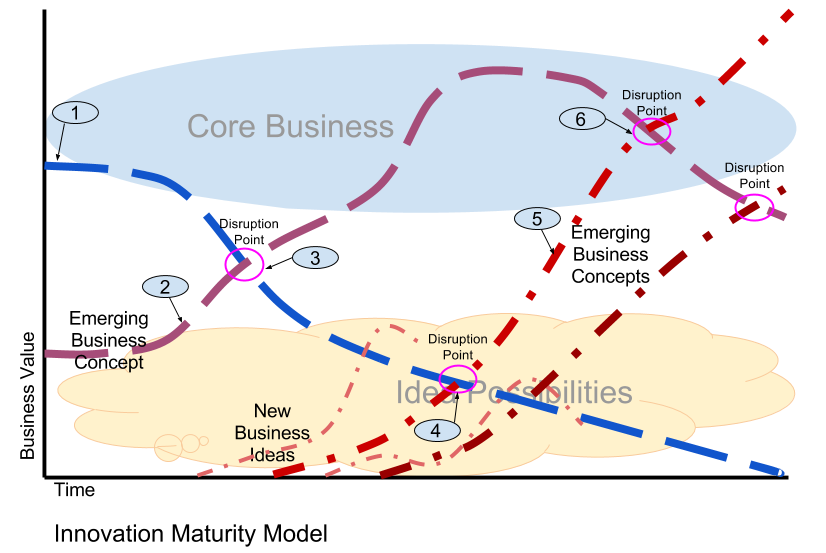
The diagram at the right shows a typical model of business ideas and services in a hypothetical organization. There is a core business [1] that creates the majority of the value and income for the organization, but there is also another line of business that is beginning to grow and prosper [2]. Eventually, it matches and supersedes the original core business and there is a Disruption Point [3] where a transition happens that changes the look and feel of the business because a new line of business becomes the dominant value creator. Now the former emerging business line becomes the primary business value generator and other less valuable ideas are being created to create value in the future. Note in this model the original core product continues to be delivered across this time, but it might not be [See Disruption Point 4]. There should be a conscious decision to either continue or quit this line of business. It takes resources of time, personnel, and capital to continue to support a dwindling value. It might be better to take those resources and put them toward other opportunities that are rising in value [5] and have greater earning potential than keeping the old line of business in place. If you consider the difference between the current value of the original core business line and its current value as a constant, if there was another opportunity that could replace that dwindling business with an increasing value business, you might be better off moving your resources to the new opportunity.
There are also other emerging ideas that break out and become competitors for the top value-earning position [5]. When this happens another Disruption Point occurs [6]. Now the organization might experience another identity crisis if it has not planned for this disruption to happen.
Your "Why" Is Important
Dealing with this constant change in how products define an organization's identity has a classic example in modern business. IBM has undergone several identity changes over the life of the company. It went from a calculator company to a typewriter company to a computing hardware company to a processing services company. Each time the change in primary revenue generation changed IBM has changed its delivery model, a little. One thing has never changed and that is their commitment to excellent service and high quality. It has been said, "Nobody ever gets fired for picking IBM." for the simple reason IBM usually delivers at least good results over long periods of time and if there is a problem, they step up with a solution. They may have changed the "what" they were known for over time, but they have never changed the Why you do business with them.
Understanding it is not the product or service, the "What", that drives a company, but rather the core principles of "Why" the business even exists at all. When you understand this principle, it is much easier to change your idea of "What" you are doing as long as you know Why you are doing it.
This is what the Ambidextrous Organization does. It is how it operates. It isn't always easy, but it is the way our modern marketplaces work now. The cycle between Disruption Points [3], [4], [6] varies between businesses, but some are as short as 24 months and others are up to 10 years, but an obvious trend has been rapidly developing that clearly indicates the period between Disruption Points is getting shorter and shorter. You might run a restaurant and think this does not affect you, but I guarantee you that it does. Your menu items, how you allow people to pay, how you seat them, or some other element in the How or "What" you deliver is probably going to change a big part of what you do, but the "Why" you serve food to people should remain the same, regardless of anything else. That "Why" is the core of your company and the sooner you figure out your "Why", the sooner you are going to be ready to compete and stay in business for as long as you want to.
Remember, you were made complete, so claim it and be happy in your life.
Other articles in the Innovation Maturity Model series: