 Introduction
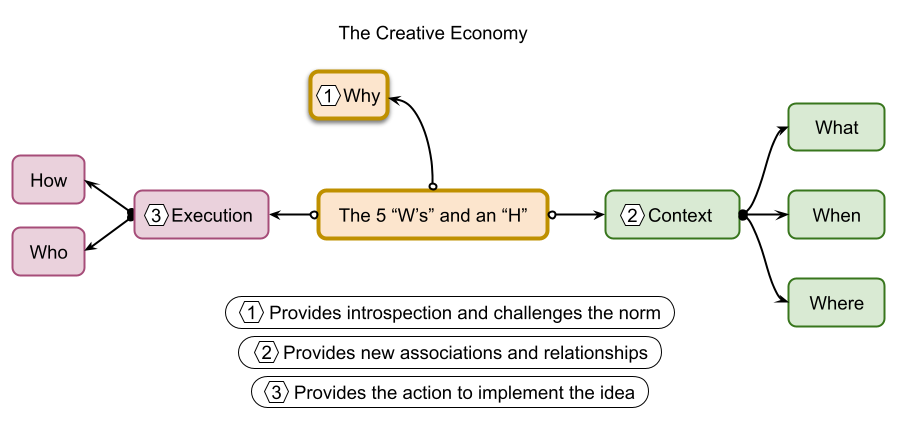
Seldom does an individual embody all the skills needed to take an idea from concept to execution, it usually takes a collection of talent embodied in a team. We have identified three distinct skill sets that are required to generate great ideas and get them to market. The Poser who asks why, the Ideator who finds the new associations, and the Doers who take the new associations and create a recipe for success.
Posers
For creativity to start there has to be change and the people who start with “Why?” get the ball rolling. They may not have any real value to contribute but to challenge the status quo. Mark Twain said it best with “The only constant is change.” We need posers to upset the status quo if we are to continue to grow and prosper. That’s a leadership question that needs answering if the question really matters, and if it does, are we going to do something about the “Why?”
Ideators
These are the folks who follow “Why” with “What”, “When”, and “Where.” They are the ones who find new associations between knowledge points, add new visions, and reveal new understandings. Here is where art, serendipity, research, supposition, and hypothesis run rampant. For many people, these are the creatives. But they would be nothing if the Posers never asked a question and the Doers didn’t finish the final details. Ideators often do not have the inclination to focus on the minute details Doers obsess over.
It is true that Ideators are a unique class of people, with special skills and they often frustrate others that want to just get something done. Ideators often wander in a land of possibilities looking for unknown associations. Testing, probing, and continuing to ask "Why", "What", and "When" for each new association. Most of the new associations will fail in some way and force the Ideator back to test more and more options. But by watching the patterns of success and failure closely, often a set of possible solutions appear. After the discovery event, Ideators begin to lose interest. The hunt is over and the chase appears to be at an end. They are ready for the next quest for “Why?”
Doers
Now it is time for the Doers to take over. Execution can make or break any idea. Often the Ideation team needs to watch over the Doers to make sure the original message is clear and understood. Here a different kind of creativity takes over. The creativity of detail and precision. Doers are the refiners and perfectionists who take rough stones, cut and polish them to make beautiful works of art. Ideas are no different.
Users
Users are the reason this work is being done in the first place. From the time someone begins to try and answer the “Why” until someone finds an answer that meets their need, the work being done is focused on that desired outcome-meeting a specified need. The idea becomes productive when someone else sees the finished work, picks it up, and uses it for themselves.
The Marketplace of Ideas is Expanding
The 867 Foundation was created to help each of the three parties, the Ideator, Doer, and User creatively participate. Each one contributes their part to what should be an improvement for everyone who identifies with the original “Why?” In the end, those who benefit from the hard work of each person who contributed to the final solution exchange some form of value to gain access to the answer they desire.
The present incarnation of the internet and pervasive access to information goes only so far. Figuring out the new patterns in the information is where creativity lives. In early 2020 Seed Scientific assembled some impressive statistics around how much data is being created. They found that at the beginning of 2020, the digital universe was estimated to consist of data totaling 44 zettabytes. If you were wondering that’s a number that has 21 zeroes. Over 90 percent of that volume was created in the last 24 months! That is a mind-bending amount of data. Just looking at the emails being sent reveals over 181 million messages are being sent every minute of every day.
Those statistics show there is a lot of information being created. But do we understand what it means? That’s where creativity arises. In our known universe, the human mind is the only truly highly creative organism. While we continue to play with the idea that we can replicate ourselves in machines, the reality is we are still a very long way off from that aspiration. Until, or if, that happens we have a lot of room to work with. Apparently, there’s more room being created every day now than ever before in the form of unrecognized understanding. That’s where recognized creativity can contribute. Some forward-looking economists have thought that today the real contribution of ideas is somewhere over 80% of the real economic activity today and that’s not in hard capital assets, that in the ephemeral world of ideas. Today, we live in a universe that spins on the axiom “If you think it, it can happen, and more and more often it will.”
Great ideas are
born from understanding
new associations of “WHY” for your
known universe, which expands and modifies
your old universe, which expands and modified your new
universe, which makes It possible to expand your new universe further.
When you get lazy and stop making new associations
your universe will begin to shrink.
The shrinking happens faster
than the expansion.
Your ideas will
evaporate.
The lesson is this:
When you get lazy you
Get flabby and you will get dumber.
Get dumber and then you die. Don’t get lazy,
that’s the secret to a long
and enjoyable life.
It doesn’t matter if you are a User, Doer, Ideator, or Poser. Everyone is contributing to the economy of creativity and ideas. Each person can extract value from the cycle of improving life. It will never be perfect, so there will always be something to do. That’s the good news for today, and apparently for a long time to come!
Go to [4 Questions to Challenge Your Ideas]
☐ ☐ ☐ END ☐ ☐ ☐
This paper is presented under the permission of the 867 Foundation, Inc., A non-profit organization created to advance the 867 Framework that outlines the use and management protocols for intangible assets so they can become recognized as unique and identifiable, tradable assets. This document is presented as an educational resource. It does not constitute legal, or financial advice. Consult your legal or financial advisors for your individual situation.
© 2019-2022 by the 867 Foundation, Inc All rights reserved.