Our Current State of Tangles

The distinction between binary vs. digital began back in the 1980s when the electronic computing community was discovering how to render the analog world into a form that electronic circuitry could interpret and reconstruct. The new technology made it easy to use electricity to store and manipulate the visual analog world. It wasn’t an exact representation, but a mathematical approximation that appeared to be the same as the original. A clever and simple method of storage was devised using a series of electro-mechanical signals, often referred to as digital storage. Only two digits are used to represent a complex method of using on and off states in a binary model. For simplicity referred to as zero and one (0 &1).
In capturing information that had been executed with analog means into a mathematical approximation, a new transformation occurred that made the repeated copying of the original very easy and inexpensive. Now it was much easier for the author or anyone else to change, leaving almost no trace behind the changes made. In many ways, this clouds the authenticity of any author. Understanding when that information was originally stored and who did the original work was not in the purview of the original creators of this mathematical method. For that matter, it is still not widely considered an important aspect of creation. It is as if we are asking everyone to create paintings and not sign their work.
 There has been a lot of work to create unique identification schemes to control individual access to electronic systems. This has been done using complex mathematics known as cryptography, but that work alone still does not help an author adequately protect their work in this ephemeral world of 1s and 0s. We seem to have created a new kind of canvas used by a host of people who use that canvas to paint wonderful ideas on. Yet, nobody can be sure of who is doing the creation or when the act of creation happened.
 The old analog world left physical evidence behind every act of creation. It was possible to know when and how the act was done, and many times by deduction, who did the work. But in the new electronic world, hardly anything is left behind that can be used to trace who did something and what they did in a meaningful way. The cryptography world would want us to use their unique keys to be the new electronic signature that positively identifies who did something. But that becomes only another artificial artifact encapsulating the original work. We still do not have an equivalent positive representation in the electronic world that we have in the physical world for positive authorship. Can we really know if the person really is the author who is applying the signature? What we need now is a way to easily authenticate the binary authorship of work done within this new electronic world.
Very little is created In today’s world that did not originate in the electronic universe or is very quickly captured in the form of pictures or sound or both. The music, video, and photography worlds are perfect examples of this transformation from analog to electronic binary artifacts. The human ear can distinguish the difference between the original analog and the electronic binary copy. This difference is enough where we pay a premium to experience the analog in person over the easily repeated electronic copy, by the simple act of going to a live performance concert or theater production.
In both instances, the live act of performance creates the authentic act of creation at that moment, and the creator is compensated. But in the electronic world, it is very easy for the author to have no way to extract a means of compensation for their work. In fact, it can be easily stolen by others without knowing the theft happened. How can we encourage creative efforts in the electronic universe and still offer authors economic protection? This is the question that has been asked over and over again since the dawn of the electronic computing age, especially since the mass adoption of the technology beginning around the advent of the new Millenium.
Untangling the Yarn
 Fortunately, there are some new ways to use old ideas to create a solution for the new electronic universe of creatives. Using some old ideas with a new twist, we can begin to see some new ways of looking at the creative process, and help creatives capture the value that belongs to them.
Part of the key is the science of cryptography married with some new ideas on how to store ideas in electronic form. While all of this still relies on the basic signals of on and off or 0’s and 1’s, the difference is how we create the patterns of signals so they can be uniquely identified. The result is what we now know as a unique distributed ledger, often referred to as "Web 3.0."
Something New from Something Old
 If a group of people all agree something was created by a person at a certain time, then by agreement it is held to be true. If we knew of a mechanism to make sure the record of that agreement is maintained, then at any time in the future what happened now can be relied on in the future. In many ways, this is the same premise historians use to verify if something in the past happened. If they can find enough evidence that matches closely, then they can either infer or confirm something did happen. The only difference in our example is there is an intentional act of agreement happening to make sure others in the future know the acts today were authentic, rather than having to find the agreement later.
This only helps with one part of the problem we identified, the WHO. We still have the problem of protecting the WHAT. The WHAT is being created as a series of on and off signals stored as the digits 0 and 1. Making sure the original pattern is maintained over time and as the original author intended is the problem at hand. If we had a secure container that would maintain the original work in a way that it could not be manipulated without the author knowing what was changed and by whom, then we could positively protect the electronic content. This would represent the secure container needed to protect the work of a creative person.
 Additionally, if each time the information is accessed there is agreement about who may read or modify the work, and what modification was made, then a permanent chain of custody gets created over time that can be read. Now everyone knows WHAT, the WHO, and the WHEN about anything in this container. This information gives us authentic proof of WHO created WHAT and WHEN it was done. This new idea is stored in a distributed ledger because multiple copies of the records are kept and if not all the copies agree where the inconsistencies exist is considered incorrect and dropped from the record of truth. Everyone who needs to know of the existence of this asset does and only knows of the result and not the means. Fortunately, the brave new world of distributed computing and blockchain ledgers provide the basis for the technology implementation to provide just such an environment to store immutable information over time, while allowing the owner to control who may see any element of descriptive information about their assets.
New Source of Property Value
We assert this is the basis for individuals to own the rights to the work they create. It ties the act of creation directly to the person as an extension of the individual. These are the “inalienable rights” referred to in the Declaration of Independence of The United States. These rights were first demonstrated in the Magna Carta and today can be defended in any court of law where the rule of law exists. This right respects the identity of a person and their creative rights as a unique person and their work product is theirs by right of creation. In today’s world of knowledge and information as a product of work, it becomes the artifact of the work and becomes a property that can be controlled by a unique person. They have the right to sell or give that work product to others in any lawful manner.
The New Intangible
This means this ephemeral existence of information and knowledge can be positively identified and controlled without explicitly revealing all the knowledge of the idea. Now it can be economically controlled to greater advantage. Which allows us to make it as tradable as a shoe or a coat or a chicken. The idea takes on the important commercial attributes of tangible property. The electronic artifact of the thought is what becomes the physical evidence of the ephemeral human thought which has value when acted upon.
This is the basis of the original intangibles clause in the US Constitution and affirmed in the Uniform Trade Secrets Act. Taking thoughts and treating them as intangible property with all the rights and privileges attributed to other registered intangible property such as trademarks, copyright, and patents. Importantly, with this class of property, the law does not require a creator to divulge their knowledge to the general public to have legal protection as in a patent or copyright. Rather, the important point is to maintain the secrecy of the key knowledge. Now the mere agreement between parties of a fact of creation by a person or persons in time is enough to create a legal protective mechanism for an idea.
Who is the Owner?
Now we have to untangle the problems we have created about ownership of ideas. If an employee works for someone that pays them for their time to create a specific work product in exchange for some form of compensation, then what they create belongs to the person giving the compensation. We call this work for hire. The product belongs to the employer, the one paying the compensation for the labor. But the knowledge of how to create that work may belong to the creator, not the employer. If the worker was trained by the employer, then all their work is derived from the knowledge of the employer. This is the model of the Master and Apprentice started by the Guilds in the Middle Ages. Until the Apprentice becomes a Master in their own right showing they can create something original of their own, all their work remains the property of their Master. Afterward, they earn the right to create their own original work. For this reason, the guilds were created by Masters to protect the larger body of knowledge and make sure it was continued.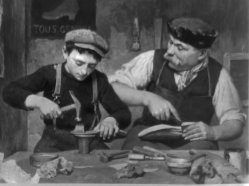
In today’s knowledge economy, how thoughts become real is how economic value is created. Just as the old craft apprentice gained experience with their materials and methods, the new knowledge worker gains experience in using the tools and methods of the new economy. They create new work from both old and new knowledge. As in the craft guilds of the past, workers today should have ownership of their original work and receive full ownership and commercial rights. The juxtaposition of employment work and ideas should not be subjected to a feudal system of possession, just because of the work association which today is often required just as a right to work.
Employment agreements should harken back to the Master and Apprentice principles where the Apprentice learned from the Master but eventually matured to become an autonomous Master in their own right, owning and controlling the work product they created. In this scenario, employers are no longer the center of intellectual assets. In the future, employers will hire many workers with their own recognized collection of intellectual property. Employers would then pay for the use of that property as they use it. Such a practice is already recognized in our civil law. It is known as a Shop License.
Rather than today's outright piracy based only on an employment association, employees retain control of their intangible property rights, much as the organized labor movement of the past century gave workers the right to receive reasonable compensation for their physical labor. Under this new economy, not only can a worker receive payment from a single  employer, but could make their ideas available to as many as were willing to pay for access to their knowledge. The origins and expansion of knowledge will no longer reside primarily in the R & D centers of corporations but be decentralized as knowledge workers find new means to both develop and deploy the fruits of their knowledge and experience.
New electronic control techniques can meter out access to as small a portion as needed, even as small as a few seconds of a digital audio track used in a marketing commercial or an algorithm used in a software solution to pay a bill or purchase a product. In this model, employees can receive payments for commercial transactions just like their corporate employers. The same mechanisms would be available to everyone and return some of the earning power to labor that has been concentrated in corporations and shop owners since commerce began.
A new kind of intellectual property market will materialize for ideas just like it does for products. A market with recognized terms and conditions and a recognized and fair dispute resolution means using both alternative dispute resolution and the established courts as needed. [Our proposal is a new model that some will find threatening, others liberating, but it addresses an imbalance of power with an answer that responds to a power imbalance as old as slavery and serfdom with one that rewards and defends innovation, invention, and unique solutions with equal treatment.]
Introducing a Standard for the New Economy
All of the basic law for the future state is already here, the problem is implementing the law to a recognizable standard. We are proposing a new Open Source standard so every business, regardless of size, can take advantage of the new 867 standards. The 867 Foundation was formed to be both the business compliance and standards organization that supports the Open Source implementation of the original framework. Since the time of the abandonment of that original effort, other appropriate technologies have been introduced that make the implementation of the 867 standards possible for everyone, not just the rich and powerful who did these transactions in the past as singular efforts to protect their business assets.
The new standard is an implementation of the old law in our new world. As previously asserted, the courts have affirmed and strengthened personal property rights law showing these laws apply to ideas as much as to physical goods. The 867 Foundation standards of practice propose new automation technologies to implement recognized ownership, chain of custody for the property, provide secure rights management for reading and user access, and automatic payment processing under a multi-party agreement that has a built-in dispute resolution mechanism.
This allows intellectual property to be transformed into intellectual capital because it creates directly attributable business value which belongs to the balance sheet of a company. It goes beyond being a collection of possible “goodwill” to becoming actual value production. This is a natural progression of the idea that humans are Analog, and Binary Computers keep Digital information (A, B, C, D). Industry professionals, like Amteah Group who adhere to the standards of the 867 Foundation are invited to be subscribing members of the Foundation.
What is standing in your way? Only your willingness to adopt the framework and adopt the 867 Foundation, and for your own best practice use an industry professional trained in the proper application of the 867 protocols. The time is right, the technology is ready, and all that is missing is your willingness to take your next step and adopt the 867 Framework.
When you embrace 867 as a framework for intellectual property protection, you begin a process that moves you toward creating more real value for your organization faster and for less cost than patents, and with more permanence than trademarks or copyright.
Visit Your Amteah Group Advisor to learn more about how you can start leveraging your Intellectual Property as Intellectual Capital today.
▢ ▢ ▢ End ▢ ▢ ▢
The Last Part of the Ideas to Assets Series
© 2018-2022 Andrew Abernathy, All rights Reserved. This document is an original creation by Andrew Abernathy and is licensed under an agreement with the 867 Foundation. It is derived from multiple sources of intellectual thought, primarily influenced by the work of Mr. Daniel Messick and Ms. Christine Miller which formed the primary body of work known as a patent filing for Canon USA in 2001 and subsequently abandoned in 2009 without having a patent issued. The work is now referred to as 867. The conclusions are solely the conclusions and property of the author. Any use or appropriation of the original ideas shall be with the written and express permission of the author. November 24, 2018, Arizona, USA. This document is provided as an educational resource it is not provided as legal or financial advice. Consult your financial and legal advisors for your specific use.